DodannylabWhat we doSep 2026
AI staffers for small companies,
sold as a monthly subscription
Small companies should not have to learn AI for their work to run on it. Beaver takes the ERP, Cheetah the website, Octo the back office. Say one line in the chat and it is built, or fixed.

Scroll
In one line
A company should not have to learn AI for its work to run on AI.
The AI itself is already good enough — ChatGPT, Claude, the ones everyone has tried. What small companies do not have is someone who turns them into their own work and keeps fixing it. Dodannylab fills that desk with an AI staffer and sells it by the month.
The problem
Price is not what stops them.
Three hundred small firms were asked why they do not use AI. Four in five said it has no place in their business. Cost came to 4.4 per cent. Nobody had shown them where AI fits in the company they actually run.
Why small firms don’t use AI (Korea Federation of SMEs, 300 firms, Nov 2024)
In the same survey, 79 per cent named training and consulting as their three-year plan, and 66.3 per cent asked for examples from businesses like theirs. They are looking for hands, not a discount.
Why tools stall
Even the ones who tried it stop there.
76 per cent of US small businesses use AI. Only 14 per cent have it inside the work that matters. Among enterprise pilots, 95 per cent never reached the P&L. MIT looked at 300 deployments and the cause was not model quality. The tools never learned how that company works, so nothing accumulated.
Goldman Sachs 10,000 Small Businesses (1,256 owners, Mar 2026) · MIT NANDA, The GenAI Divide (300 deployments, Aug 2025)
In the same report, 67 per cent of deployments built with an outside partner succeeded, against 33 per cent built in house. Someone from outside has to attach to the company and learn it.
The answer
It does not build and leave.
It stays inside the company.
Software shops build and leave. After that, every line costs another quote. Packaged vendors make the company fit the product instead. Neither one learns the company. What we sell is one desk, filled, inside that company. $360 a month.
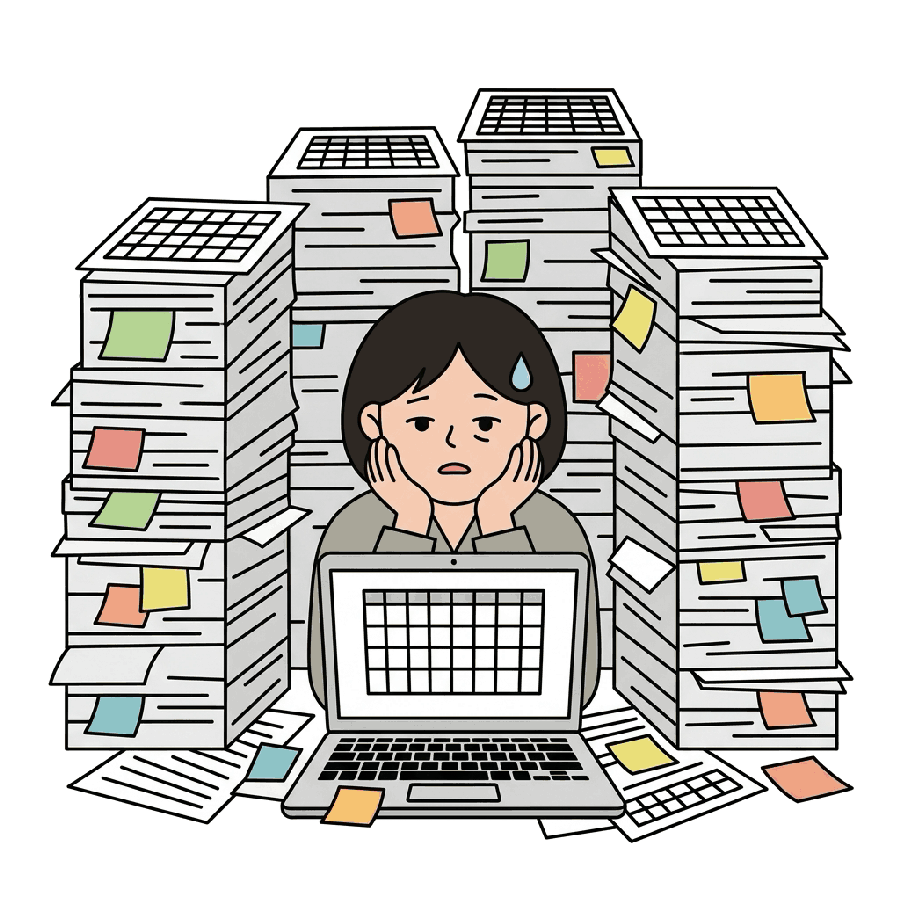
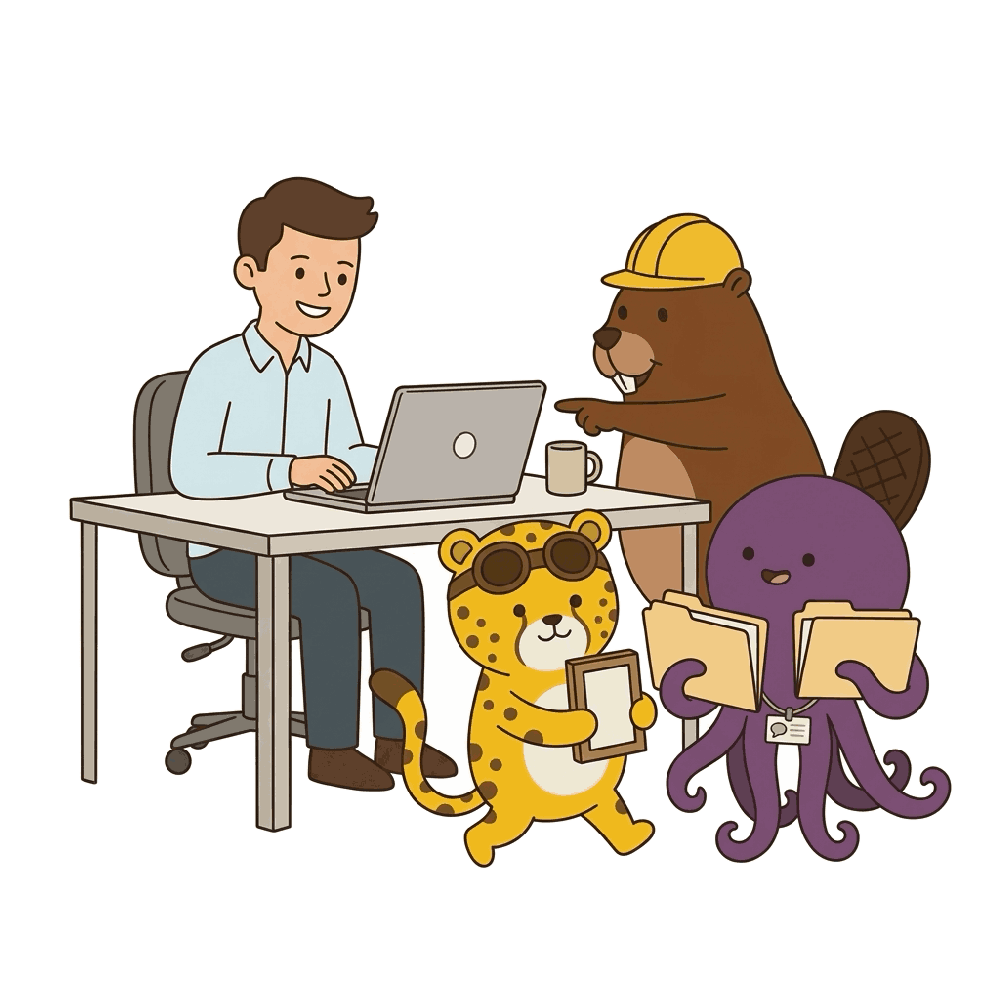
Give a company a tool and the company has to learn it.
Put a staffer at the desk and it learns the company.
Hold support and skill equal, and that gap falls from 13.8 points to 4 (Korea Chamber of Commerce, 3,000 employees, Jun 2026).
- Nothing to learnno spec document, no training. You say what gets in the way, where it gets in the way
- One company, one serverserver, database and repository per company. Nothing mixes, and on the way out it all leaves with you
- Failure is not billed onno credits, no usage caps. The staffer fixing its own mistake does not cost the customer
Product
Three desks today. ERP, website, back office.

BeaverERP
Builds the software your company runs on, and fixes it when you say so.
Beaver plan $360 / month
CheetahWeb
Builds your company website and changes it the moment you ask.
Cheetah plan $72 / month
OctoCrew
A staffer who watches the chat rooms your company already works in.
Octo plan $360 / month
The next desk
When another job turns up inside a company, we open another desk for it. Standing one up takes days.
Why now
One person can now build for eighteen companies at once.
Custom software used to cost tens of thousands up front. As the AI got better, one person with agents can build and keep several companies' systems at the same time, and that is what makes a few hundred dollars a month possible. The buying side is ready too: 51 per cent of US small business owners are experimenting with AI and 73 per cent want help putting it in (Goldman Sachs, Mar 2026).
Market
Big companies already bought. Small ones had nothing to buy.
99.9 per cent of Korean businesses are small firms. What was sold to them was packaged software that did not fit, agency builds they could not afford, and no-code they had to learn. Our seats are the companies held together by spreadsheets, by phone calls to an agency, by chores nobody owns.
Korean Ministry of SMEs and Startups 2021 · Software Policy & Research Institute · our own 2026 quotes
The engine
The desks differ. The machine underneath does not.
From a request to a deployment, no human hand is in the path. That is why standing up another desk takes a day — the third one, Octo, did.
- Saythe chat beside the screen, or the Slack you already use. One line.
- Sessionone agent per company. It reads that company's intent map and request history, then builds.
- Checksvoice, screen and rollback checks stand between the work and the answer. Going around them is logged.
- Shipto that company's server only. Time from request to deploy and the number of rollbacks are counted.
- Opswhen work piles up, another window opens. Only anomalies reach a person. Nobody sets the window count by hand.
Speed
Request to screen, 24 minutes at the median.
The expensive part of buying software is not the price, it is the waiting. Two weeks for a quote, three months to build, and a fix has to wait for the next release. Take that queue away and a company uses software differently. It stops putting up with things and says them as they come.
Measured over 113 requests at the two companies using it (7–18 Sep 2026)
- To the first screennot months of requirements and development. You see something running in the first conversation
- To a changeno quote, no waiting for a release. It is fixed and published where you said it
- To another deskno new contract, no new onboarding. It starts the same day in the chat you already use
Business model
They arrive with one desk and stay with several.
Billing counts desks. A company that has lived with one takes the next easily, not because we have more to sell but because the server, the accounts and the way of asking are already inside that company. Nothing has to be decided again. One of our two customers already runs two.
| Animal | Plan | Plus plan |
|---|---|---|
| BeaverERP | $360 / monthBeaver plan | from $720 / monthBeaver plus plan |
| CheetahWeb | $72 / monthCheetah plan | from $144 / monthCheetah plus plan |
| OctoCrew | $360 / monthOcto plan | from $720 / monthOcto plus plan |
One server per customer, so another desk adds AI usage and little else. The server runs $11 to $22 a month per customer. A card is registered once and charged monthly, and overseas customers get a payment link each month. We plan to open one new desk a year, so the same customer buys more as the years pass.
So far
Two weeks old. Three desks, two customers.
Opened 5 September 2026. A nursing hospital and an accounting firm are on Beaver and Cheetah, one of them on both at once. 113 requests in eleven days, 21 on the busiest one. Eleven minutes to the first reply at the median, twenty-four from asking to live on screen, and not one request took longer than an hour.
Registered as a sole proprietor. Business registration and mail-order filing inside a month
BeaverERP site and customer portal live. Contracts and automatic billing in the same pass
Second animal, CheetahWeb. Seed, site, trial server and promotion in three days
Two plans across the board, an English edition, ad measurement, first invoice issued
Promotion from trial server to customer server proven in the field, with expiry locks
Third animal, OctoCrew. One day
OctoCrew gets its own address, octocrew.io. Company site, dodannylab.com
Competition
Everyone else sells tools. We sell the person at the desk.
Packaged ERP asks the company to fit the product. Agency builds put a quote between you and every change. No-code and AI builders have to be learned, and their credits burn on the AI's own mistakes. Gartner expects over 40 per cent of agentic AI projects to be cancelled by the end of 2027 on rising cost and unclear value (Jun 2025). You survive here by fixing the price and eating the cost of failure.
| Packaged ERP | Custom agency build | No-code / AI builders | Dodannylab | |
|---|---|---|---|---|
| Shaped like your company | no | yes | halfway | yes |
| Changes without a quote | no | no | halfway | yes |
| Nothing to learn | no | yes | no | yes |
| You don’t pay for the AI’s mistakes | — | — | no | yes |
| Own server, own data, per company | no | yes | no | yes |
| A few hundred dollars a month | halfway | no | yes | yes |
Roadmap
More desks, fewer human hands.
Opened · Beaver, Cheetah and Octo live · two customers · this site
Card billing live · English ads · Octo’s first customer · first customer from an ad
A fourth animal · no human hands between the first chat and the subscription · 24 companies, 1.3 animals each
A fifth animal · the seed is the running code · past the line where more animals stop needing more people · 59 companies, 1.5 each
A sixth animal · several animals per company is the norm · overseas billing in double digits · 108 companies, 1.7 each
Year five. $1.8M in annual recurring revenue · 181 companies, 320 animals between them
Team
One person, many agents.
Gilrok Do, founder. The person settles contracts, money and direction. Building, shipping and watching are the agents' work. Whatever customers live with, the founder lives with first, on the same tools. Dodannylab's own website is a Cheetah customer.
- Operationsthe ops server keeps a session per customer and cycles every two minutes. People see anomalies only
- Knowledgeintent map, wiki and daily records stand in three layers, and agents read them at every fork
- Rulesseven lines a session must not cross, held by documents, hooks and after-the-fact audits

Financial goal
$1.8M in annual recurring revenue by year five.
Two forces stand this curve up. The number of companies grows, and the number of desks inside each company grows with it. The first three years are flat because they go into animals and the engine, and the end stands up because customers grow without people growing with them.
Customers at year end times average monthly subscription. The average moves from $430 to $830 not because prices go up, but because the desks one company runs go from 1.2 to 1.8 and some of them move up to plus. The 181 companies are not served by a hundred hires. The premise is crossing the line by 2028 where more customers stop needing more people, and missing it bends the curve down in 2029. Today it is $790 a month across two customers, one of them running two desks. That is the leftmost point, and everything to the right is a goal.
Together
Partnership, the next desk, or a question.
What we are looking for now is channels to sell through and the next desk to take on. Any of those conversations is welcome. Leave a note and we will read it and reply.